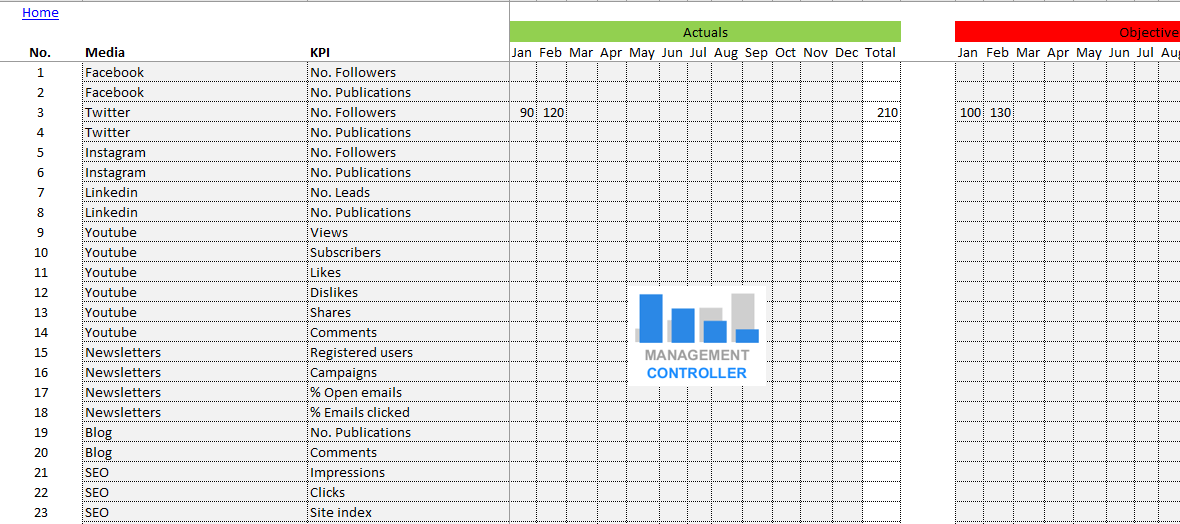
Digital Marketing Dashboard Excel Template to Track Campaign KPIs

A digital marketing dashboard Excel template helps turn scattered campaign data into a clear monthly view of traffic, leads, conversions, cost, CPA, ROAS and channel performance.

Digital marketing creates a lot of numbers. The problem is not usually lack of data. The problem is knowing which numbers matter and how to read them together.

This free Excel template is designed to help marketing teams, small businesses, consultants and managers review digital marketing performance without getting lost in disconnected reports.

Digital Marketing Dashboard Excel Template

A digital marketing dashboard Excel template is a spreadsheet used to track and summarize the main KPIs of digital marketing campaigns.

It can help review:

  • Website traffic.
  • Leads generated.
  • Conversion rate.
  • Marketing spend.
  • Cost per lead.
  • Cost per acquisition.
  • Return on ad spend.
  • Performance by channel.
  • Monthly campaign results.

The purpose is not to replace Google Analytics, advertising platforms or CRM systems. The purpose is to create a management view that connects the most relevant metrics in one place.

Why a marketing dashboard is useful

Digital marketing reports can easily become too fragmented.

One platform shows traffic. Another shows ad spend. Another shows leads. The CRM may show opportunities. Accounting may show sales. Each tool has part of the truth.

A marketing dashboard helps bring that information together.

It helps answer questions such as:

  • Which channels are generating traffic?
  • Which channels are generating leads?
  • Which campaigns are converting better?
  • How much does each lead cost?
  • Is paid traffic producing profitable results?
  • Are conversions improving or getting worse?
  • Where should the next marketing effort go?

Without a dashboard, teams may celebrate vanity metrics while missing the real business signal.

What this digital marketing dashboard should include

A useful digital marketing dashboard should not include every possible metric. It should include the metrics that help make decisions.

1. Traffic KPIs

Traffic is usually the starting point, but it should not be the only KPI.

The dashboard can track:

  • Sessions.
  • Users.
  • Page views.
  • Organic traffic.
  • Paid traffic.
  • Referral traffic.
  • Direct traffic.
  • Traffic by campaign.

Traffic shows visibility, but visibility alone does not guarantee business results.

2. Lead generation KPIs

If the website or campaign is designed to capture prospects, the dashboard should include lead KPIs.

For example:

  • Total leads.
  • Leads by channel.
  • Leads by campaign.
  • Contact form submissions.
  • Downloads.
  • Demo requests.
  • Newsletter sign-ups.

This helps separate traffic that only visits from traffic that actually takes action.

3. Conversion rate

Conversion rate shows the percentage of visitors or clicks that become leads, customers or another defined goal.

A basic formula is:

Conversion rate = Conversions / Visits

For example, if a campaign generates 2,000 visits and 80 leads:

80 / 2,000 = 4%

A campaign with lower traffic but higher conversion rate may be more valuable than a campaign with many visitors and few results.

4. Marketing cost and CPA

Marketing performance should also be linked to cost.

Useful indicators include:

  • Total marketing spend.
  • Cost by channel.
  • Cost per click.
  • Cost per lead.
  • Cost per acquisition.
  • Budget consumed.

A simple formula for CPA is:

CPA = Marketing cost / Acquisitions

This helps management understand whether growth is being bought at a reasonable cost.

5. ROAS and campaign return

For paid campaigns, ROAS can be useful.

ROAS = Revenue generated / Advertising spend

For example, if a campaign spends 1,000 and generates 4,500 in revenue:

ROAS = 4.5

This means the campaign generated 4.5 in revenue for every 1 spent on advertising.

ROAS should be interpreted carefully because revenue is not the same as profit, but it is still a useful performance indicator.

Digital marketing dashboard vs marketing plan

This page should not be confused with a marketing plan.

A marketing plan defines what the company wants to do: objectives, target audience, channels, actions, calendar, budget and responsibilities.

A digital marketing dashboard measures what is happening after those actions are launched.

So the difference is clear:

  • Marketing plan: what are we going to do?
  • Marketing dashboard: what results are we getting?

Both tools should work together, but they are not the same.

Digital marketing dashboard vs CRM report

A dashboard may track leads, but it is not a CRM.

A CRM report focuses on leads, opportunities, customers, pipeline stages, sales activities and deals.

A digital marketing dashboard focuses on the marketing performance that generated those leads.

For example:

  • Marketing dashboard: which campaign generated the lead?
  • CRM report: what happened to that lead after sales contacted it?

If the business wants to connect marketing with sales results, both views are needed.

Digital marketing dashboard vs budget control

Marketing spend is part of the dashboard, but this template is not a full budget control file.

Budget control usually compares actual expenses against a planned budget and analyzes financial deviations.

A marketing dashboard goes further into performance:

  • What did we spend?
  • What traffic did it generate?
  • How many leads came from it?
  • How much did each lead cost?
  • Which channel performed better?

The dashboard connects cost with results.

Channel performance: where the dashboard becomes useful

One of the most valuable parts of a digital marketing dashboard is the comparison by channel.

For example:

  • Organic search.
  • Paid search.
  • Social media.
  • Email marketing.
  • Referral traffic.
  • Direct traffic.
  • Affiliate campaigns.

A channel with high traffic may not be the best channel if it produces few leads. A smaller channel may be more valuable if it generates better conversion or lower cost per lead.

This is why channel-level analysis matters.

Practical example: traffic is not the full story

Imagine two campaigns:

Campaign Visits Leads Conversion Rate
Campaign A 5,000 100 2%
Campaign B 1,500 90 6%

Campaign A brings more traffic, but Campaign B converts better.

If the team only looks at visits, Campaign A seems stronger. If the team looks at leads and conversion rate, the picture changes.

A dashboard helps avoid this type of mistake.

What decisions can this dashboard support?

A digital marketing dashboard can help decide:

  • Which campaigns should be increased.
  • Which campaigns should be stopped.
  • Which channels deserve more budget.
  • Where conversion problems may exist.
  • Whether cost per lead is acceptable.
  • Whether paid campaigns are generating enough return.
  • Whether organic traffic is improving.
  • Whether marketing activity is supporting sales objectives.

The dashboard should not only show numbers. It should help decide what to change next.

Common mistakes in marketing dashboards

Some dashboards look impressive but are not useful.

Common mistakes include:

  • Including too many metrics.
  • Mixing vanity metrics with business KPIs.
  • Not separating traffic by channel.
  • Tracking leads without conversion rate.
  • Tracking cost without cost per lead or acquisition.
  • Reviewing campaigns without comparing periods.
  • Not connecting marketing metrics with sales outcomes.
  • Using inconsistent data sources.

A good dashboard should be easy to read and difficult to ignore.

How to make a digital marketing dashboard more useful

A practical dashboard should include different levels of reading.

For example:

  • Executive summary.
  • Monthly KPI evolution.
  • Channel comparison.
  • Campaign detail.
  • Cost and conversion analysis.
  • Comments and action points.

The comments section is important. Numbers without interpretation often lead to meetings where everyone sees the same dashboard but draws different conclusions.

When Excel is useful for marketing reporting

Excel can be useful when the company needs a flexible management report.

It allows you to:

  • Combine data from different sources.
  • Create custom KPI views.
  • Compare campaigns manually.
  • Prepare monthly reports for management.
  • Add comments and explanations.
  • Adapt the report to the company’s real needs.

The value is not replacing marketing platforms. The value is creating a clear control layer above them.

When Excel is no longer enough

Excel may become limited when marketing data volume grows.

A company may need business intelligence, CRM integration or automated dashboards when:

  • Campaign data changes daily.
  • Several platforms must be connected automatically.
  • Sales attribution is complex.
  • Multiple countries or brands are managed.
  • Real-time dashboards are required.
  • Marketing and sales data must be fully integrated.

Even then, Excel can remain useful for analysis, but operational reporting may need automation.

A digital marketing dashboard Excel template helps track marketing KPIs such as traffic, leads, conversion rate, CPA, ROAS and channel performance.

It is not the same as a marketing plan, CRM report or financial budget control file.

Its role is specific: help managers understand whether digital marketing activity is producing measurable results.

A useful dashboard does not try to show everything. It shows the numbers that help decide what to improve next.

This digital marketing dashboard Excel template can be combined with other marketing, CRM, sales and KPI control tools depending on whether you need to monitor online performance, plan campaigns, manage leads or connect marketing results with business objectives:

marketing plan Excel template when you need to define marketing objectives, campaigns, actions, budgets and responsibilities before measuring results in a dashboard.

CRM Excel template when digital marketing actions generate leads and you need to manage contacts, opportunities, follow-up and sales pipeline.

sales budget control template in Excel when you need to compare sales performance against budget after marketing campaigns start generating commercial results.

Balanced Scorecard Excel template when marketing KPIs need to be connected with broader strategic objectives, business perspectives and management follow-up.

action plan Excel template when dashboard deviations need to be converted into specific marketing actions, owners, deadlines and review tasks.

Frequently Asked Questions about Digital Marketing Dashboards in Excel

What is a digital marketing dashboard Excel template?

It is a spreadsheet used to track and summarize marketing KPIs such as traffic, leads, conversions, costs, CPA, ROAS and channel performance.

What KPIs should a digital marketing dashboard include?

It may include traffic, leads, conversion rate, cost per lead, CPA, ROAS, CTR, channel performance and campaign results.

Is a marketing dashboard the same as a marketing plan?

No. A marketing plan defines actions and strategy. A dashboard measures campaign results and marketing performance.

Can Excel be used for marketing KPI reporting?

Yes. Excel is useful for combining data, preparing monthly reports and creating custom marketing KPI dashboards.

When should marketing reporting be automated?

When data volume is high, reports are needed frequently, several platforms must be connected or marketing and sales attribution becomes complex.


Digital Marketing Dashboard Control Excel Template

Download this Template here


Excel File Download

More information about Controlling Tools

Controlling and Financial Excel Templates

ERP ODOO Functional Consultant and Controller (Management Control & Controlling)

Dani Granero

Dani-Consultant-Controller--ODOO

More INFO and contact