
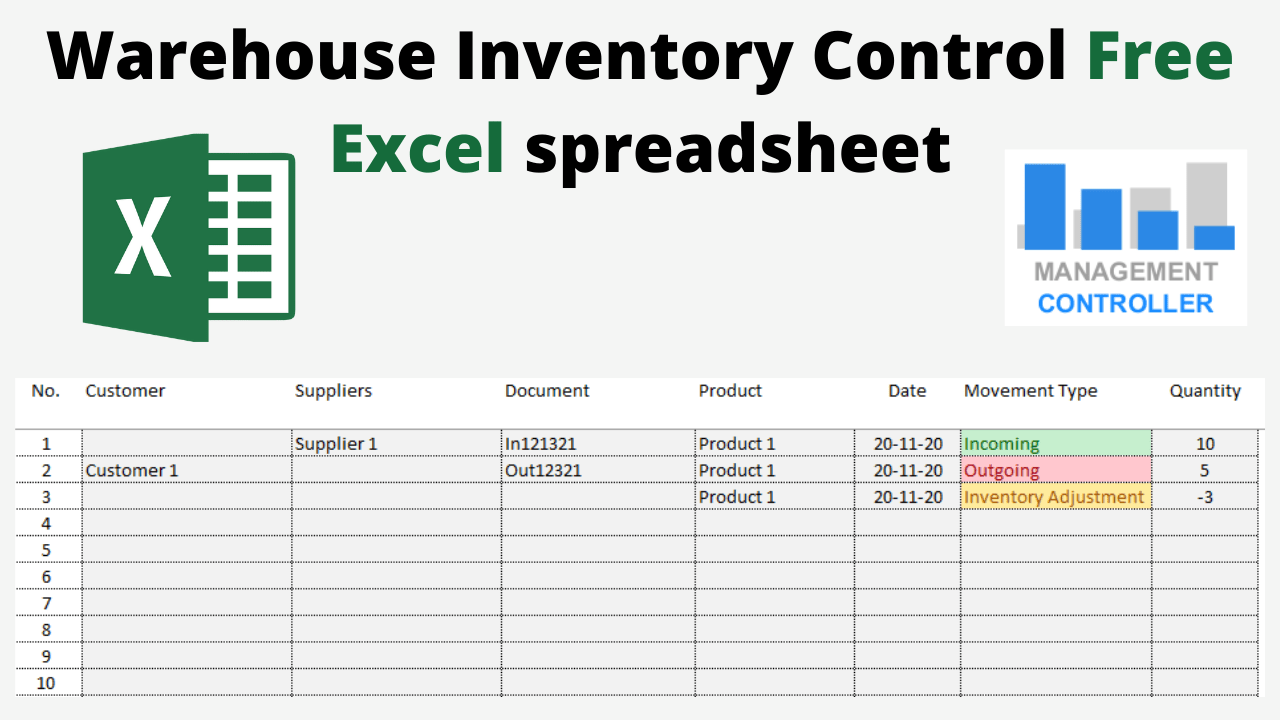
A warehouse inventory control Excel template helps you track stock in, stock out, adjustments and available quantities without losing visibility of what is actually happening inside the warehouse.
Inventory problems usually start small: a missing entry, an unrecorded stock issue, a manual adjustment with no explanation, or a product stored in the wrong location. Over time, those small differences become bigger operational and financial problems.
This free Excel template is designed for basic warehouse control: products, movements, quantities, locations and stock balances.
Warehouse Inventory Control Excel Template
A warehouse inventory control Excel template is a spreadsheet used to record and monitor the basic movements of stock inside a warehouse.
It helps answer simple but important questions:
- What products do we have in stock?
- How many units are available?
- What stock has entered the warehouse?
- What stock has left the warehouse?
- Which products have been adjusted manually?
- Where are products located?
This page focuses on operational inventory control. It is not mainly about procurement planning, supplier comparison or inventory KPI analysis. Those are related topics, but they solve different problems.
Why warehouse inventory control matters
A company can sell well and still have warehouse problems.
If inventory records are not reliable, the business may face:
- Stockouts even when the system shows available units.
- Excess stock that nobody notices on time.
- Urgent purchases caused by poor visibility.
- Differences between physical stock and spreadsheet stock.
- Unexplained inventory adjustments.
- Delays in preparing orders.
- Financial reports based on weak stock data.
Good inventory control is not only a warehouse task. It affects purchasing, sales, customer service, cash flow and profitability.
What this inventory control spreadsheet should include
A simple inventory control file does not need to be complicated, but it should be structured properly.
1. Product master list
The product master is the base of the template.
It should include:
- Product code or SKU.
- Product description.
- Category or family.
- Unit of measure.
- Warehouse or location.
- Minimum stock level, if required.
- Active or inactive status.
A clean product list prevents confusion between similar references and reduces manual errors.
2. Stock in records
Stock in records show the quantities entering the warehouse.
These movements may come from:
- Supplier deliveries.
- Customer returns.
- Production receipts.
- Positive inventory adjustments.
- Transfers from another warehouse.
Each stock entry should include the date, product, quantity, reference document and comments if needed.
3. Stock out records
Stock out records show the quantities leaving the warehouse.
These may be related to:
- Customer shipments.
- Internal consumption.
- Returns to suppliers.
- Scrap or damaged products.
- Negative inventory adjustments.
- Transfers to another location.
Recording stock out movements correctly is essential to avoid inventory balances that look correct in Excel but are wrong in reality.
4. Inventory adjustments
Adjustments should never be invisible.
They should be recorded with:
- Date of adjustment.
- Product code.
- Quantity adjusted.
- Reason for adjustment.
- Person responsible, if applicable.
- Comments or reference.
Frequent adjustments may reveal deeper issues: missing procedures, counting errors, theft, damaged goods or poor warehouse discipline.
5. Available stock calculation
The basic stock formula is simple:
Available stock = Opening stock + Stock in – Stock out +/- Adjustments
The important part is not the formula. The important part is making sure that every movement is recorded consistently.
Warehouse control vs stock planning
Warehouse inventory control and stock planning are connected, but they are not the same thing.
A warehouse inventory control template tells you what happened and what you currently have available.
A stock planning or procurement template helps you decide what should be purchased, when and in what quantity.
So the difference is clear:
- Inventory control answers: what stock do we have and how did it move?
- Stock planning answers: what should we buy to avoid shortages or excess inventory?
If your main problem is recording stock movements, this inventory control template is the right starting point. If you need purchase recommendations, replenishment logic or procurement simulation, you need a stock planning model.
Warehouse control vs inventory KPIs
This page should also be separated from inventory KPI analysis.
Inventory control tracks quantities and movements. Inventory KPIs analyze performance.
For example:
- Inventory control: 250 units are available today.
- Inventory KPI analysis: the product has low rotation and 180 days of coverage.
Both views are useful, but they are not the same.
First you need reliable stock records. Then you can analyze rotation, coverage, excess stock, slow-moving items and inventory efficiency.
Who can use this warehouse stock tracker?
This template can be useful for:
- Small businesses with a simple warehouse.
- Retail companies tracking product quantities.
- Workshops managing spare parts.
- Service companies controlling materials.
- Manufacturing companies tracking basic stock movements.
- Online sellers that need a simple inventory file.
- Managers who want to move away from informal stock records.
It is especially useful when the business is not yet ready for a full ERP or warehouse management system but needs more control than memory, notes or scattered spreadsheets.
Benefits of using Excel for warehouse inventory control
Excel can be a practical starting point for basic inventory control.
Some benefits are:
- Fast implementation.
- No complex software required.
- Easy customization.
- Clear stock movement records.
- Simple available stock calculation.
- Useful for small teams and simple warehouses.
- Good starting point before moving to an ERP.
The key is to avoid using Excel as an uncontrolled notebook. The spreadsheet should have a clear structure and a consistent way of recording movements.
Common warehouse inventory mistakes
Inventory errors often come from small habits repeated every day.
Some common mistakes are:
- Recording purchases but forgetting internal consumption.
- Adjusting stock manually without explaining the reason.
- Using different product names for the same item.
- Not separating stock in, stock out and adjustments.
- Not checking physical inventory regularly.
- Ignoring damaged or obsolete products.
- Mixing available stock with reserved stock.
- Using one spreadsheet with no clear owner.
These mistakes make inventory information less reliable and create friction between sales, warehouse and purchasing.
When Excel is no longer enough
Excel works well for simple inventory control, but it has limits.
You may need an ERP or warehouse management system when:
- There are many products and frequent movements.
- Several users update stock at the same time.
- Multiple warehouses or locations must be controlled.
- Lot numbers or serial numbers are required.
- Stock reservations must be linked to sales orders.
- Inventory valuation must be connected to accounting.
- Purchasing, sales and warehouse operations need real-time integration.
At that point, Excel may still be useful for reporting, but the operational stock process should probably move to a more integrated system.
How to get more value from this inventory template
A stock control template should not only show quantities. It should help detect patterns.
For example:
- Which products are adjusted too often?
- Which items frequently reach zero stock?
- Which products remain in storage for too long?
- Which locations create more errors?
- Which movements are not being recorded on time?
These questions turn a simple inventory file into a practical management control tool.
Practical example: from stock movement to management decision
Imagine a product with the following movements during the month:
- Opening stock: 100 units.
- Stock in: 80 units.
- Stock out: 140 units.
- Negative adjustment: 5 units.
The available stock would be:
100 + 80 – 140 – 5 = 35 units
The number itself is useful, but the management question is more important:
- Why was there a negative adjustment?
- Is 35 units enough until the next delivery?
- Should purchasing review this product?
- Is demand higher than expected?
Inventory control is the first step. Better decisions come from reading the movements behind the number.
A warehouse inventory control Excel template is a simple way to track stock in, stock out, adjustments and available quantities.
It is useful for small businesses and teams that need a clear operational record of warehouse movements without implementing complex software from day one.
This template should be used for inventory control. For procurement planning, supplier comparison, stock rotation analysis or inventory valuation, it should be complemented with more specific tools.
This warehouse inventory control Excel template can be combined with other stock, procurement and profitability tools depending on whether you need to track stock movements, plan replenishment, compare supplier prices or connect inventory decisions with margins:
stock planning and procurement simulator Excel template when you need to plan future purchases, replenishment quantities and procurement decisions instead of only tracking current stock movements.
supplier price comparison Excel template when purchasing decisions depend on comparing supplier prices, offers and procurement alternatives before updating inventory.
retail profit analysis Excel template when inventory control needs to be reviewed together with sales, margins, product categories and store profitability.
direct costing Excel template when stock movements and product costs need to be connected with variable costs, contribution margin and profitability analysis.
payments forecast Excel template when inventory purchases, supplier invoices or procurement commitments need to be organized by due date and future cash outflow.
Frequently Asked Questions about Warehouse Inventory Control in Excel
What is a warehouse inventory control Excel template?
It is a spreadsheet used to record products, stock entries, stock exits, adjustments and available quantities in a warehouse.
Can Excel be used to manage inventory?
Yes. Excel can be useful for basic inventory control, especially in small businesses with simple warehouse operations.
What should an inventory control spreadsheet include?
It should include product codes, descriptions, opening stock, stock in, stock out, adjustments, locations and available stock.
Is inventory control the same as stock planning?
No. Inventory control tracks stock movements and balances. Stock planning helps decide what to buy and when to replenish.
When should a company stop using Excel for warehouse control?
When there are many products, multiple users, several warehouses, lot tracking, real-time reservations or inventory valuation linked to accounting.

More information about Controlling Tools
- Cash Flow Forecast Template in Excel for Business Liquidity Planning
- Balanced Scorecard Excel Template for Strategic KPI Management
- Manufacturing Standard Cost Excel Template. Costs and Product Margins
- Supplier Price Comparison Excel Template for Purchasing Decisions
- Payments Forecast Excel Template. Track Upcoming Supplier Payments
- Selling Price Calculation Excel Template: 3 Practical Pricing Methods
- Training Management Excel Template. Track Employee Courses and Skills
- Working Hours Timesheet Excel Template to Track Employee Hours
- OEE KPI Report Excel Template. Track Availability, Performance and Quality
- Hotel Cost Calculation Excel Template for Rooms, Occupancy and Profitability
- Multiproduct Break-Even Excel Template with Sales Mix Simulator
- Customer Invoices Excel Template to Create, Track and Manage Invoices
- Actual vs Budget Excel Templates for Variance Analysis
- Product BOM Cost Excel Template. Calculate Component Cost Step by Step
- Employee Management Excel Template for Staff Records and HR Control
- Cash Flow Control Excel Template. Track Cash Inflows and Outflows
- Project Cost and Profitability Excel Template. Plan vs Actual Control
- Retail Profit Analysis Excel Template for Store Margins and KPIs
- Travel Expenses Excel Template to Track Trip Costs and Reimbursements
- Sale Price List Excel Template. Calculate Prices, Margins and Markupsility
- Home Budget Excel Template to Track Household Income and Expenses
- 5-Year Business Plan Excel Template for Long-Term Budget Planning

ERP ODOO Functional Consultant and Controller (Management Control & Controlling)
